Sourcing hotel building supplies from China can involve many products, factories, documents, and delivery dependencies. Buyers can reduce avoidable gaps by controlling the project package, coordinating quality references, naming supplier and site responsibilities, comparing delivery assumptions, planning packaging and receiving, and routing every change to the right approver.
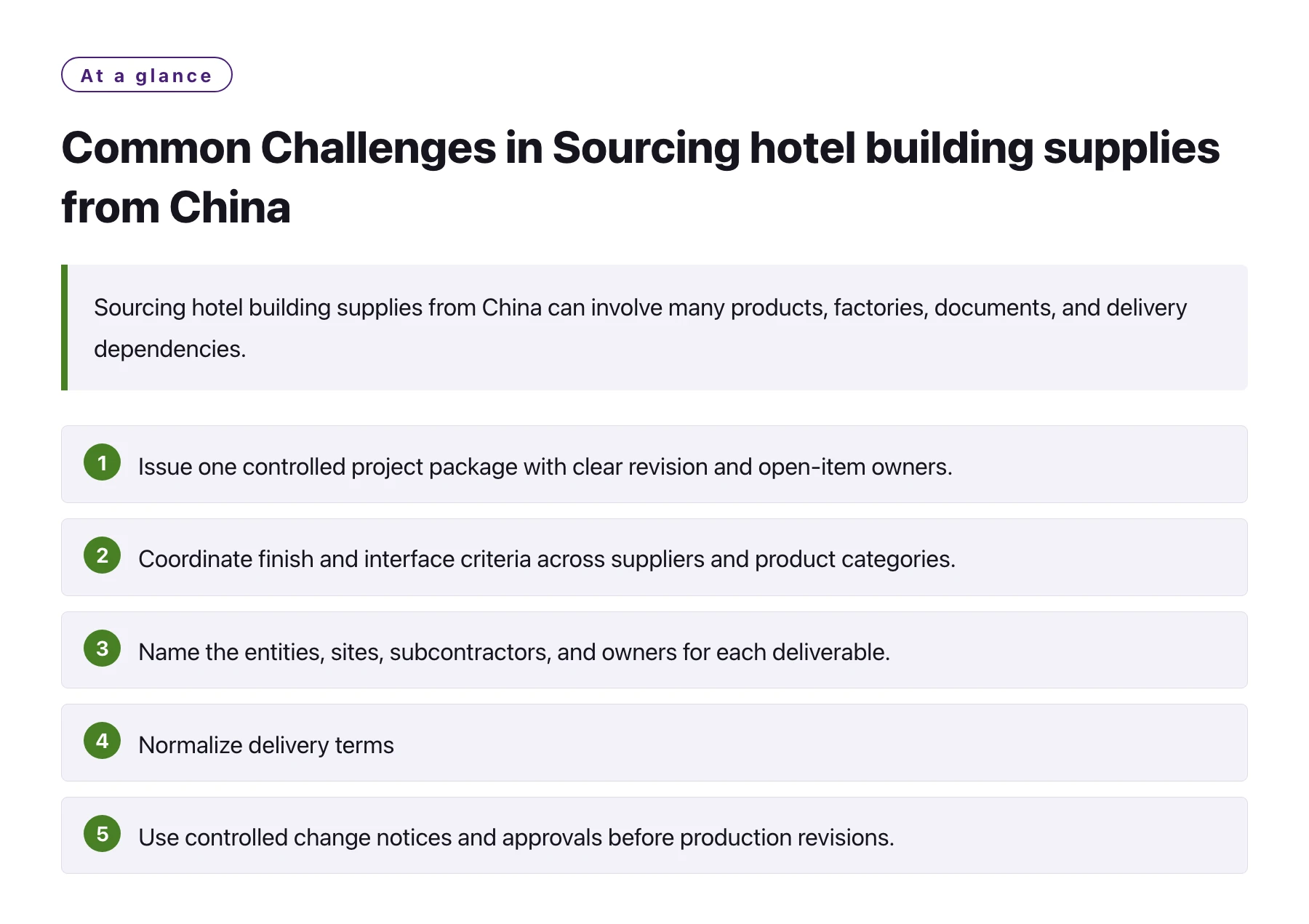
Key takeawaysIssue one controlled project package with clear revision and open-item owners. · Coordinate finish and interface criteria across suppliers and product categories. · Name the entities, sites, subcontractors, and owners for each deliverable. · Normalize delivery terms, costs, schedules, packaging, and receiving requirements. · Use controlled change notices and approvals before production revisions.
Hotel supply orders connect product specification to room schedules, construction access, delivery sequencing, and opening dates. The procurement plan should make those dependencies visible to each supplier.
Challenge: the project package is not frozen
Hotel building supplies are often specified across drawings, finish schedules, room data, hardware lists, and procurement packages. If the supplier receives different revisions from the designer, operator, contractor, and buyer, the quotation may price a mixture of requirements. Create one current package with document numbers, dates, and an order of precedence for resolving conflicts.
Identify the items included in each room or public-area package. State dimensions, materials, finish, performance, accessories, samples, tolerances, quantities, and installation interfaces. Distinguish confirmed selections from placeholders and identify who can approve alternates. A supplier should not infer a final finish or count from a presentation rendering when a controlled schedule exists.
Create an open-item log with question, affected product, owner, due date, and commercial or schedule impact. Keep a hold point for unresolved safety, code, or interface requirements. This lets the team move forward on unaffected items while protecting the items that still need a design decision.
Challenge: quality varies across a coordinated package
A hotel project may combine furniture, lighting, fixtures, finishes, and accessories from different factories. Define quality requirements by product and by visible interface. Color, sheen, grain, dimensions, and hardware behavior may need to coordinate across vendors even when each supplier’s individual product passes its own checks.
Approve representative samples or mock-ups before production. Identify the exact supplier, model, material, finish, and revision for each approval. Where several suppliers must match a shared finish, establish a common reference, viewing conditions, and tolerance owner. Keep retained samples protected and accessible during final inspection.
Use an inspection plan that checks the characteristics with the greatest project impact. Record product identity, lot, sample basis, actual findings, photographs, and disposition. A single inspection visit cannot establish consistency across every later production lot, so require traceability and change notice.
Challenge: supplier and site responsibilities are blurred
Clarify which entity contracts, manufactures, exports, installs, and provides after-sales support. A project may involve a sourcing intermediary, factory, subcontractor, freight forwarder, local installer, and property owner. Put a name beside each deliverable and interface so the team knows who provides drawings, samples, packing details, certificates, and replacement parts.
Confirm which supplier site and subcontractors are approved. If production is split across factories, identify how revisions, finish references, inspection results, and packing instructions are controlled. A commercial group affiliation does not automatically mean the quality system or process at each site is identical.
For site-dependent work, identify who verifies dimensions, tolerances, utilities, wall conditions, access, lifting, and installation sequence. State which party owns field measurements and who may approve a change. Product supply and installation coordination should not be treated as one undifferentiated service.
Challenge: quotations are priced on different delivery assumptions
Normalize offers by product scope, quantities, packaging, samples, tooling, currency, validity, and delivery point. Ask each supplier to identify exclusions such as export packaging, documentation, insurance, consolidation, destination charges, and inland delivery. A low factory price may omit work another bidder includes, so compare total delivered cost and assigned responsibility.
Choose the delivery term and named place deliberately. The ICC Incoterms® 2020 checklist maps buyer and seller responsibilities for delivery, costs, and risks across the rules.[1] The term should be written with its version and precise named location, then matched to the parties’ actual freight, customs, and insurance arrangements.
Confirm lead-time assumptions and when the clock begins. Hotel opening dates may depend on a coordinated package, so record production milestones, inspection windows, cargo-ready dates, and receiving appointments. For consolidated shipments, identify the slowest items and decide whether partial delivery is possible without disrupting installation.
Challenge: packing is planned too late
Ask suppliers to design packaging for the product, route, container, handling equipment, and site storage. Furniture corners, glass, polished surfaces, long trim, and fragile controls may need distinct protection. Specify carton labels, room or package identifiers, pallet dimensions, stack limits, and any moisture or shock controls justified by the product.
Plan warehouse receiving and hotel-site access early. Check container unloading space, elevator capacity, corridors, floor protection, staging area, and delivery sequence. Packages that fit a shipping container may not fit a service lift or a room doorway. Record whether suppliers must pack by room, floor, installation zone, or item type.
Connect packing lists to room schedules and purchase orders. If labels need a room number or installation sequence, approve the format before production. This reduces sorting and prevents a correct shipment from becoming difficult to allocate at the property.
Challenge: approvals and changes do not reach every supplier
Use a document register and distribution list for specifications, drawings, samples, and approved changes. When an item changes, identify affected purchase orders, supplier sites, quotations, production lots, and packing labels. Ask suppliers to acknowledge the new revision and state how superseded documents are withdrawn.
Name authorized approvers for design, quality, compliance, price, and schedule. A supplier may propose an alternative, but it should not become a production change until the appropriate owner approves it and the commercial impact is recorded. Keep approvals accessible to the factory and inspector, not only in a project office archive.
For sourcing and coordination of hotel building supplies, buyers may consider hotel furniture and equipment sourcing as one resource. Define the actual categories and services required, verify supplier and delivery responsibilities, and retain project approval with the named design and procurement owners.
Sources
Frequently asked questions
What information should be included in a hotel supply request?
Include controlled drawings and schedules, product dimensions and finishes, quantities, samples, performance needs, interfaces, packaging, delivery point, milestones, and named approval owners.
How can different supplier quotations be compared?
Normalize product scope, quantities, exclusions, packaging, currency, delivery term, named place, and lead-time assumptions. Record all deviations against one project package.
When should room-by-room packing be specified?
Decide during logistics planning, before production packaging begins. Check how room identifiers, installation sequence, warehouse staging, and site access affect carton labels and delivery batches.
Who should approve a supplier substitution?
Assign the decision to the project’s named design, technical, quality, and commercial approvers as relevant. Record the revised specification and any cost or schedule impact before production.