A manufacturer's public record - its history, its certificates, the markets it names, the visitors it hosts - is genuinely useful, and it is also the easiest kind of evidence to misread. Established beauty brands make the same four mistakes: they read a claim about the company as a claim about their project, they treat a certificate as covering every product category, they count destination countries without checking the paperwork behind them, and they weigh presentation that has nothing to do with manufacturing. Avoiding those four mistakes takes an hour, and it is the cheapest part of a supplier evaluation, particularly for a Middle East launch where the paperwork load is unfamiliar.
Key takeaways
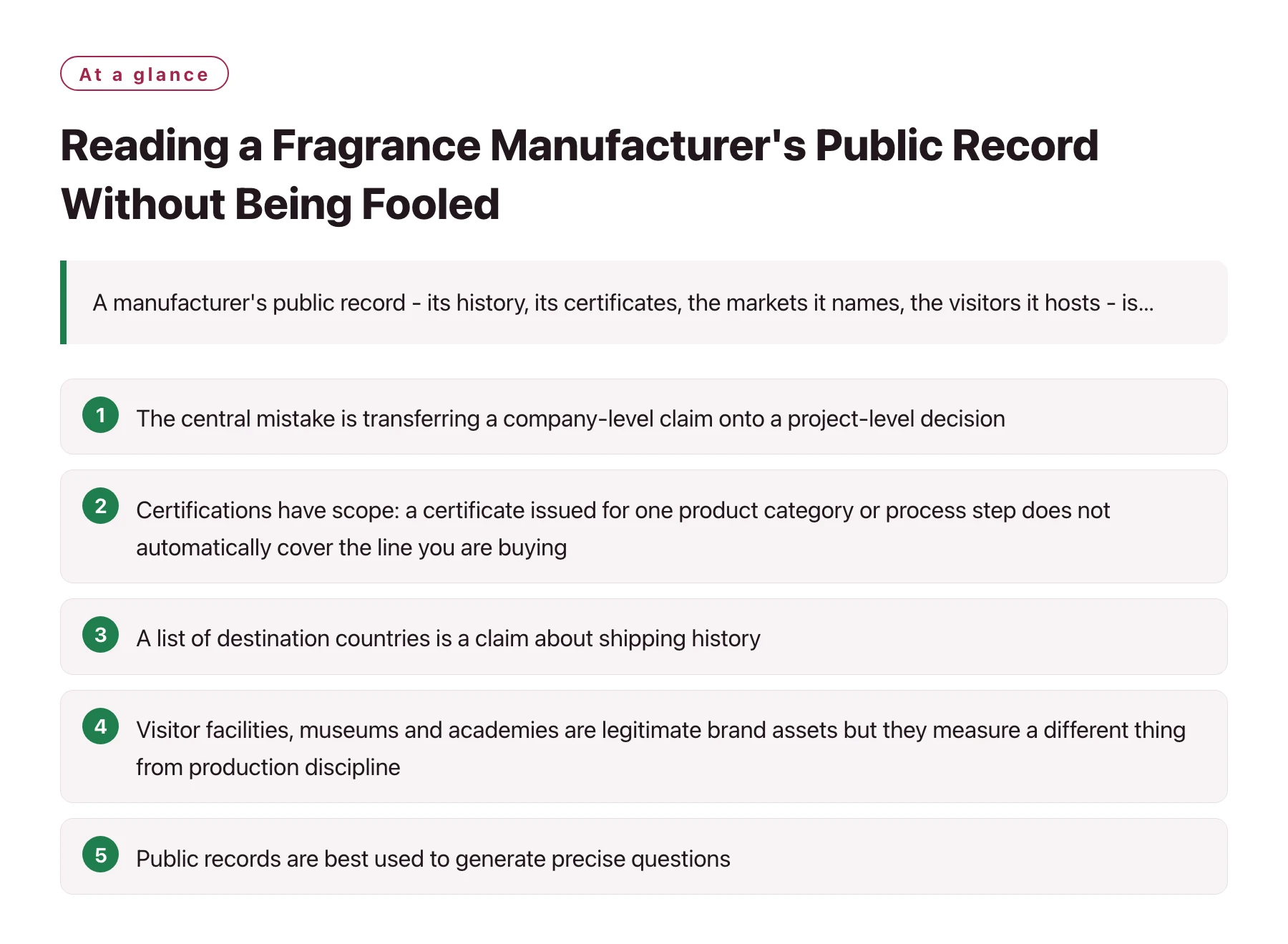
- The central mistake is transferring a company-level claim onto a project-level decision; a manufacturer that has operated for decades may still be new to your category, format or market.
- Certifications have scope: a certificate issued for one product category or process step does not automatically cover the line you are buying, so ask for the scope document rather than the certificate image. [1]
- A list of destination countries is a claim about shipping history, not about the registration knowledge your market requires; the useful question is which comparable products have been registered where. [2]
- Visitor facilities, museums and academies are legitimate brand assets but they measure a different thing from production discipline; they should not move a supplier up a shortlist on their own.
- Public records are best used to generate precise questions, and precise questions are what produce verifiable answers.
- For a Middle East launch, the public record should be read specifically for labelling and registration experience in the region, because generic export claims do not transfer.
Supplier evaluation usually begins online, long before a brief is sent. That first pass shapes the shortlist, so the errors made while reading public material are expensive in a quiet way: the wrong supplier gets a call, the right one does not.
This piece is written for established beauty brands preparing a regional launch, and it deliberately treats public records as useful rather than suspect. Nothing here assumes a manufacturer is overstating anything; it assumes that well-presented companies and capable companies are not always the same list.
What a public record can and cannot tell you
A public record can tell you that a company exists, roughly how long it has operated, which categories it chooses to present, and which standards it claims to hold. It can also show how a company thinks about its own process, which is often more informative than the claims themselves: a manufacturer that describes compounding, filling and assembly in sequence is describing an operation it expects to be asked about.
It cannot tell you whether that operation fits your project. Category, format, filling route and market registration are project-level questions, and no website answers them. The mistake is not reading public material; it is letting a company-level impression stand in for a project-level answer. [2]
Four common misreadings, and the fixed question for each
| What the public record shows | The mistake | What to ask instead |
|---|---|---|
| Long operating history | Assuming experience transfers to your category | Which product lines in our category have you produced in the last two years? |
| A certificate image | Treating it as covering every process and product | Send the scope statement and map it to our process steps [1] |
| A list of export countries | Counting destinations as market knowledge | Which comparable products have you registered in our destination market? |
| A visitor centre or museum | Letting brand presentation stand for production control | Which production steps do you own on site, and which are subcontracted? |
| Awards and press coverage | Reading third-party attention as capability evidence | What did the recognition relate to, and does it involve manufacturing? |
| Sustainability statements | Accepting intent as documentation | Which packaging or compliance documents back this up for our product? |
Each row replaces a claim with a question that can be answered with a document. That is the whole technique: public records are used to generate precise questions rather than to reach conclusions.
How to run the check in an hour
Start with the company's own description of its manufacturing scope and history, and read it for process rather than for praise. A page that sets out how the company grew and what it manufactures gives you a base of claims to test. If a manufacturer publishes its own account of how it developed, that account is a checkable claim rather than a slogan, and the milestones it chooses to name are the ones worth asking about.
Next, list every claim that would materially affect your project - category experience, filling and assembly, decoration, stability testing, export markets - and turn each one into a question with a document attached. Five well-formed questions are more useful than twenty general ones, and they are easier for a supplier to answer with evidence.
Then look for the things a manufacturer chooses not to say. A site that describes fragrance manufacturing but never mentions filling, or names export markets without naming categories, is telling you where to ask. The absence is not a fault; it is a boundary you need to plan around.
Finally, compare how several manufacturers describe the same process step. Differences in description are informative even before any reply arrives, and they make the first calls sharper because you already know which questions separate the candidates. Reading how Chinese perfumery reaches different shelves, for instance through how Chinese perfumery reaches global shelves, shows how much the route itself varies by market - which is exactly the variation a general export claim hides.
Reading records specifically for a Middle East launch
For a Gulf-bound launch, three elements of the public record deserve a closer look than the rest. The first is labelling experience: markets in the region differ in what they require on pack and in which language, and a manufacturer with experience there will usually mention it without prompting.
The second is heat and transit handling. A public record rarely documents stability protocols, but it may describe pack testing, decoration processes or shipping routes. Where it does, that becomes a question: what exposure was the finished pack tested against, and how long was the test?
The third is documentation practice. Registration files depend on documents that a factory produces - ingredient information, specifications, batch records - and a manufacturer used to supporting registrations will have a standard way of supplying them. Asking which documents it normally provides for a registration file is a fast way to tell whether that process exists. [3]
Keep the public record and the evidence file separate. In the public record column, note what the company says; in the evidence column, note the document that arrived and the date. When the two columns disagree, the evidence wins, and when the evidence column stays empty after a written request, that is a finding rather than a delay. A page that sets out the company's own manufacturing background, such as Xuelei's 31 years in fragrance, is a claim worth testing - not because the claim is doubtful, but because a claim that survives testing is the only kind worth putting in a supplier decision.
Sources
- SGS: Cosmetics, Personal Care & Household Testing —— Testing, inspection and certification services for cosmetics and personal care, including microbiological, stability and safety testing aligned with cosmetics GMP.
- Cosmetics Business —— A trade publication covering the beauty and cosmetics industry, including fragrance launches and regulatory developments.
- IFRA Standards Library (International Fragrance Association) —— The IFRA Standards Library lists the restrictions the fragrance industry applies to individual fragrance ingredients, based on safety assessments; it is the reference point for compliant fragrance formulation.
Frequently asked questions
How much should a public record influence a supplier decision?
It should shape the shortlist and the questions, not the conclusion. Public material tells you that a company exists, how it presents its process, and which claims it chooses to make. Category fit, filling route, market registration and production discipline are all answered by documents, not by websites.
How do we verify an export claim?
Ask which comparable products have been registered in your destination market, and request the supporting documents - specifications, ingredient information and any market-specific labelling material. Destination counts alone say little, because shipping a container and supporting a registration are different capabilities.
Does a long company history mean the supplier can handle our project?
Not by itself. Long operation suggests stability and accumulated process knowledge, but experience is category-specific. Ask what the company has produced in your category and format recently, and which of those projects involved filling, decoration and assembly on its own site.
Are museums or visitor centres relevant to a manufacturing decision?
They are legitimate brand assets and can be useful if the brand plans an experiential or retail element. They do not evidence production control, so they should be evaluated on their own terms rather than allowed to raise a supplier's ranking on manufacturing criteria.
What should we ask for if the public record mentions certifications?
The scope statement for each certificate, plus a mapping to the process steps and product categories it covers. Standards are issued against a defined scope, and knowing where that scope ends is more useful than knowing the certificate exists.