What 'Private and Secure Environment' Means for Adult Chat
"Private and secure environment" is a claim you can test rather than trust, and the test starts with what the phrase does not say. The platform pairs it with "state-of-the-art encryption" on its adult chat page; neither phrase is a promise of absolute anonymity, and neither needs to be. Three device habits and two policy pages are enough to decide whether the environment suits you.

Key takeaways
- Read the client's wording, not a paraphrase: the platform says "private and secure environment" and "state-of-the-art encryption", never that nothing can go wrong.
- Most risk sits on your side of the screen: lock screens, notification previews and shared browser profiles leak more than transport in practice.
- Two policy pages answer objections in writing - the content removal policy for reports and the complaints policy for process.
- Volume matters for exposure: 18 messages a day is 540 a month, and that is the number to weigh against a privacy habit you cannot keep.
Translating the claim into four checks
The phrase "private and secure environment" tells you the platform treats the conversation as something belonging to one account. What it does not tell you is anything about the device that account is signed in on, and that is where nearly every practical leak happens. The useful reading is therefore not "am I invisible" but "where does this conversation exist, and who else can reach those places".
The page's own description is of chat with Sex AI companions that adapts to your personality, and its privacy wording sits in the same passage. The second half of the client's phrasing, "state-of-the-art encryption", describes protection in transit and at rest. It is a statement about how the service is built, and the honest way to hold it is alongside the rest of the published wording rather than above it. Phrases of this kind are precise and limited by design; they are not a guarantee, and any article that upgrades them into one is telling you about the article rather than the platform.
There is also a factual boundary worth stating plainly. The platform's 2257 compliance statement says its content is AI-generated text, that no real person is depicted, and that the site does not produce images or video. That matters for privacy in a specific way: there is no photorealistic material of a real person to leak, and the parts of this habit that are yours to protect are your account, your device and your notes.
Where adult chat actually leaks
Consider the ordinary failure cases. A phone left face up while a notification preview shows a message. A laptop signed into the same browser profile as a partner's or a colleague's account. A password manager that fills an address on a shared machine. A tab left open in a session that someone else uses. None of these are platform problems, and all of them are commoner than anything the client's wording is designed to address.
The fix is a short list rather than a long one. Lock the device that holds the account. Turn notification previews off for the app you use, so an alert cannot reproduce a message on a lock screen. Keep the platform in its own browser profile if the machine is shared, and sign out rather than closing the window when you are finished. Those three items cover most of the realistic exposure for a habit of this size.
Then decide about volume, because exposure scales with the amount of material that exists. Messages accumulate in a conversation, and 18 messages a day is 540 in a 30-day month. If reviewing or clearing an account would be difficult at that volume, the habit that keeps it manageable is a weekly check rather than an annual one - two minutes spent looking at what your account contains, once a week.
| Check | What to look at | A good answer looks like |
|---|---|---|
| Device access | Whether the phone or laptop holding the account is locked and not shared | A lock screen you control and a browser profile nobody else uses |
| Notification behaviour | Whether message previews appear outside the app | Previews off, or the app installed with no notification permission |
| Published policy | The 2257 statement, the content removal policy and the complaints policy | Written pages that state what the content is and how a report is filed |
| Content footprint | How much accumulates in a month at your usual pace | A volume you are willing to review on a schedule, not in an emergency |
Worked example: sizing a habit against a privacy routine
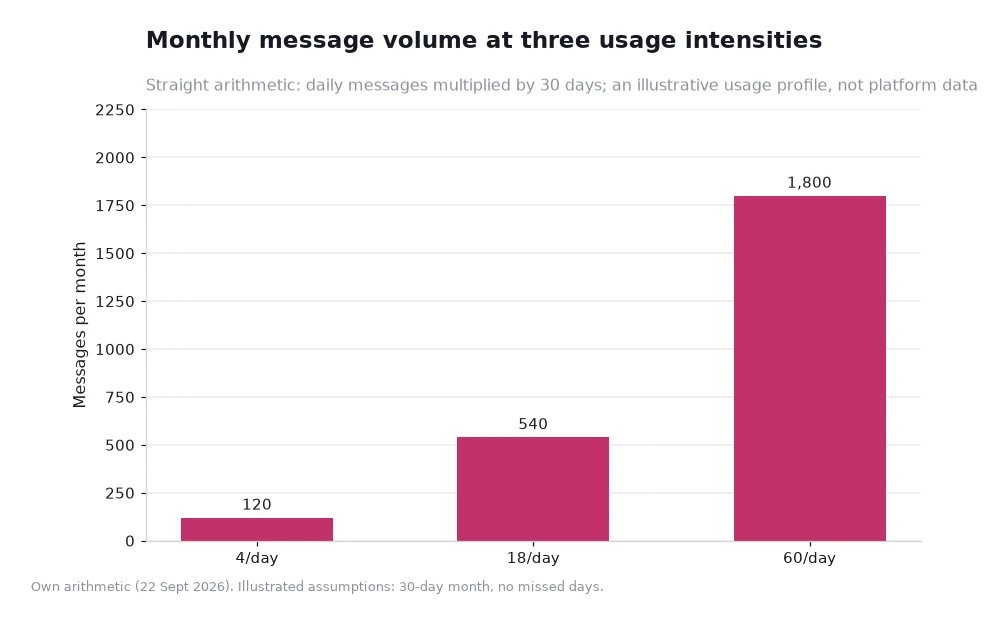
Use the chart figures first. Daily counts multiplied by 30 days give 120 messages a month at 4 a day, 540 at 18 a day and 1,800 at 60 a day. The middle figure is the one most readers recognise: 540 messages is 270 minutes of typing at 30 seconds each, or 4.5 hours.
Now price the routine in the same units. Locking a device costs nothing ongoing. Turning previews off is a one-time minute. A weekly account check at two minutes is 8 minutes a month, which is 3% of 270 minutes of typing, and the sign-out habit is roughly 10 seconds per session - 2 minutes a month at 12 sessions. The whole privacy routine is under 12 minutes a month against a 4.5-hour habit, which is about 4%.
That ratio is the argument. If a privacy habit costs a tenth of the activity it protects, it gets kept; if it costs as much as the activity, it gets abandoned within a fortnight. The arithmetic is illustrative and built to make that comparison, not a measurement of anyone's account.
Using the pages that exist for objections
If something in a conversation is wrong - a description that misleads, or content that steps outside the platform's guidelines - the published route is a report from the content item itself, and the content removal policy sets out how that request is handled. The same policy names an address for reports that do not fit the in-page route, and the complaints policy covers process rather than content.
Read those three pages once, at the start, the same way you would read the terms of anything you intend to use regularly. It takes about ten minutes in total and answers most of the questions that otherwise become forum threads. Anyone who tells you an unfiltered platform has no limits has not read the platform's own FAQ, which says some limitations apply under its content and community guidelines.
Then settle the question you actually asked. The client's phrase describes the environment it built; the checks above describe the environment you are using it in, and only the two together decide whether this is a private habit. If your device habits are sound and the volume is one you can review, a sex ai conversation on a platform with published compliance pages is a manageable thing to run - with the wording read at its own value rather than as an absolute.
Frequently asked questions
Does "state-of-the-art encryption" mean nothing can leak?
No phrase of that kind means that, and the client does not make that claim. It describes how the service protects data, while device access and notification settings remain on your side.
What is the quickest useful privacy change?
Turning off notification previews, or installing the app without notification permission. It removes the most common way a message becomes visible to somebody else.
How often should an account be reviewed?
Weekly is enough for most readers. Two minutes a week is about 8 minutes a month, roughly 3% of the 270 minutes that 540 messages a month take to type.
Check your side of the screen first
Before forming a view about a privacy claim, spend five minutes on the device in front of you: lock it, kill the previews, keep it out of shared profiles, and sign out when you finish. Then read the policy pages once so that the word "private" has a written meaning rather than a feeling attached to it. If both checks pass, the environment is as private as your own habits allow, and the honest measure of that is not a slogan but the routine you can keep for a year.
Data: client wording and policy pages from the Crushon site and the 2257 statement, read 22 Sept 2026[1][2]. Message and routine figures are own arithmetic, presented as an illustrative profile rather than platform data. Written for adult readers; the service is offered to those aged 18 and over.